

How Your Nervous System Shapes Your Reactions and Your Reality
Learn how your body influences your emotions, behaviour and sense of identity

Prefer to listen? Here’s the audio version by Jon:
’ I’m anxious.’
’ I’m too sensitive.’
’I need to be quiet.’
For years, these were the stories I told myself. I didn’t think I could ever change them until I discovered how my nervous system worked. Understanding it was reacting to ‘perceived threats’, and in its own way, trying to protect me, was a liberating insight. I could stop blaming myself for behaviour I never consciously chose.
Don’t get me wrong, today I still get anxious, and I still blush way too easily when I get embarrassed. But now, I can work with my body’s responses rather than blaming myself.
Knowing how the nervous system works will help you better understand why you react the way you do. And give you more choice in how you respond to life’s challenges.
Read on to learn how and why vagus nerve ‘hacks’ miss the bigger picture. And discover three practical tools to help calm your nervous system.
Your nervous system is running the show
Here’s the simplest way to understand it: Your body is constantly scanning the world, asking: ‘Am I safe?’
This happens before your thinking mind engages.
Stephen Porges, the creator of Polyvagal theory, calls it neuroception. Your body’s unconscious detection of safety or threat operates without conscious awareness.
If it senses safety, you feel calm, confident, connected.
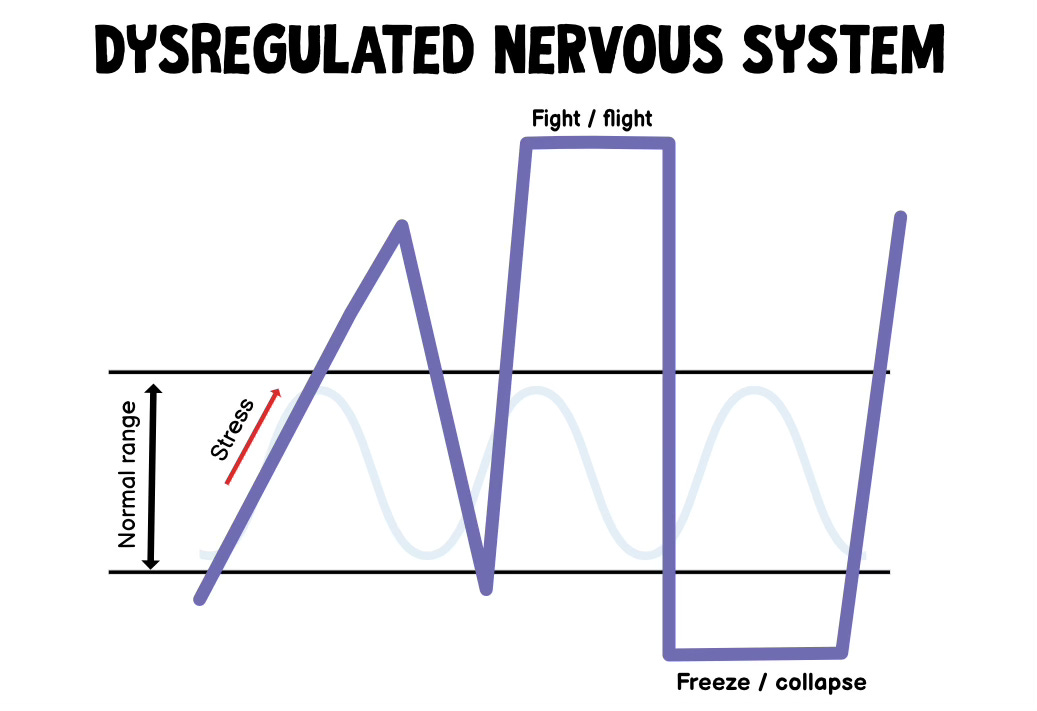
If it senses danger, your system responds with fight, flight, or freeze. Your instinctive survival responses.
Fight: You get angry or aggressive.
Flight: You avoid or escape.
Freeze/collapse: You shut down or disconnect.
Self-awareness begins in the body
Your self-worth rises or falls with how safe your nervous system feels.
It’s not just about mindset. It’s physiology.
Raja Selvam, in his book The Practice of Embodying Emotions, offers an insightful observation. When you increase your capacity to feel emotion in the body, your mind becomes clearer, calmer, and less reactive.
Here, capacity means how much emotional or physical sensation your system can handle without shutting down. When capacity is low, small things feel big. When it’s high, life feels more manageable and open.
A healthy nervous system is about regulation. The ability to return naturally to equilibrium after stress and overwhelm. Achieving this level of regulation is not a hack you can do in 5 minutes; it’s deep, sustained work.
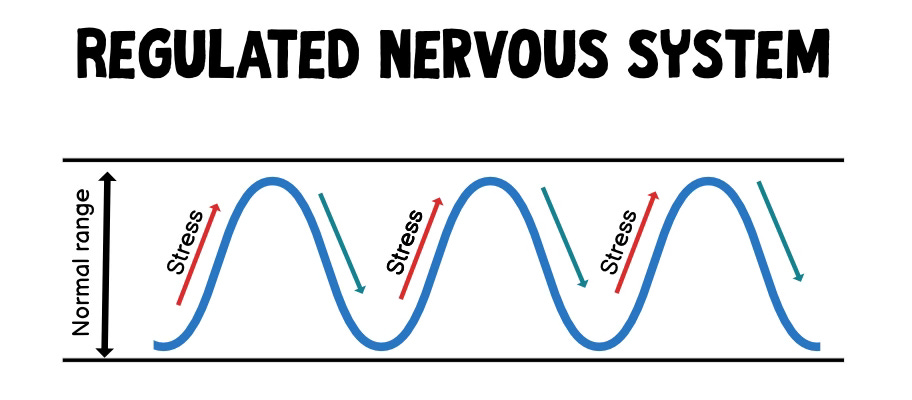
Nervous system regulation underpins confidence, boundaries, and emotional resilience. A dysregulated nervous system creates dis-ease, distress, and an overall sense of chaos in your body and often in your life.
Why the vagus nerve isn’t a relaxation hack
That brings us to one of the most misunderstood pieces of the nervous system puzzle: the vagus nerve.
Somewhere along the way, it became a trend.
‘Hack it.’
‘Tap it.’
‘Stimulate it.’
And yes, some of that helps.
But here’s the truth: the vagus nerve, a key part of your parasympathetic nervous system (your ‘rest and digest’ branch), isn’t a switch you flip.
It influences heart rate, digestion, and emotional regulation, but not on command.
Authentic vagal tone (how well this system works) is about:
Flexibility: shifting smoothly between states.
Capacity: staying present without overwhelm.
Safety: a grounded sense of ‘I’m okay’.
It’s less ‘press here to relax,’ more ‘How well can you move between the states of activation and calm?’
Here, activation means your system is alert, not necessarily in danger, but primed to protect.
When you understand your nervous system, life makes sense
Suddenly, you get it:
Freeze in conflict? Your body feels unsafe and shuts you down to protect you.
Overwhelmed and numb? That’s your system going into energy-conservation mode. A deep form of withdrawal often linked to the freeze response.
Snapping at people you love? That’s your stress response, sometimes called fight or flight, kicking in to defend you.
Struggle to ‘think positive’ when stressed? Your thinking brain goes offline when your body feels under threat.
Find it hard to set boundaries? Your nervous system may be stuck in survival mode, where pleasing others feels safer than standing your ground.
There’s nothing wrong with you. Your system is doing its job.
When you understand that, you stop fighting yourself and start working with yourself.
3 ways to gently help your nervous system
I want to give you three basic tools that can help you return to that more open, regulated state.
Each of these exercises may land differently for you, and you may even find that they don’t calm you; they instead stimulate you. Give them a try and see how they feel.
1. Grounding
(Adapted version of an exercise from nervous system expert Irene Lyon.)
This is useful when you are feeling overwhelmed. You can also use it in calmer moments, when stress is low, to build resilience and help you cope more effectively with stress.
The first few times you do it, take it slow, and then find a pace that works for you.
How to do it
Bring your attention to your breath without changing it, softening your face and jaw.
Feel your feet on the ground while continuing to be aware of your breath.
Now bring your attention to your hands, sensing their shape, weight and presence while still being aware of your breath.
Then bring your awareness to your pelvis and legs, noticing the support they provide as you breathe.
After a pause, take a breath in, hold for a second, then gently sigh it out.
How it helps
The purpose is to reduce overwhelm by reconnecting you with your body. Making it easier for you to process stress and emotions. The emphasis is on remaining present with intense feelings rather than avoiding them.
2. Orienting (Deb Dana)
Orienting is the simple practice of reminding your nervous system that the present moment is safe.
When you feel overwhelmed or stressed, your attention narrows. The nervous system goes on high alert, scanning for danger. This is a survival pattern. In threatening environments, it helps you focus on what’s wrong.
But in safe settings, it can trap you in a loop of hypervigilance or anxiety.
How to do it
You can try this for 30 seconds or more, whatever works best for you.
Turn your head slowly around your environment.
Let your eyes rest on objects around you, a window, a tree, a patch of sunlight…
Linger on what feels pleasant or neutral.
Notice colours, shapes, textures.
Let your breath settle naturally.
Why it helps
Your nervous system uses visual cues to determine safety.
When you look around and see nothing threatening, you begin to relax. It gives your system evidence that you’re safe. This is one of the quickest ways to interrupt a stress spiral and return to the present.
3. The voo hum (Peter Levine)
When the body holds onto stress or trauma, it often gets stuck in a loop of activation.
Peter Levine is the founder of Somatic Experiencing. He discovered that certain sounds and vibrations can help release that stuck energy. One of the most effective and accessible is the Voo Hum.
This practice sends soothing vibrations through the diaphragm, chest, and throat. This stimulates the vagus nerve, which plays a central role in calming your nervous system.
It’s not about forcing yourself to relax; it’s about gently giving your body a cue of safety, using sound.
How to do it
Take a slow, deep breath in.
On the exhale, make a low, drawn-out “Voooooo” sound, deep and steady.
Feel the vibration move through your chest and belly.
Pause (If you have never done this before, do it once to see how it lands, then repeat if it feels good).
Repeat 3–5 times, letting your awareness rest on the physical sensation.
Pause after each Voo and notice any softening.
Why it helps
The vagus nerve responds especially well to vibration and resonance.
This technique indirectly stimulates it. Inviting the body out of fight-or-flight and into a more grounded, connected state. Many people report feeling calmer and clearer after just a few rounds. It’s also worth noting that some may feel slightly sleepy rather than stimulated.
What this really means
Understanding your nervous system isn’t just about learning biology.
It’s about learning about yourself, your body and your reactions. When you recognise your state, you stop identifying so much with your reaction.
‘Why am I like this?’ becomes, ‘Oh. That’s my nervous system reacting. It thinks I’m not safe.’ It helps you feel more grounded. More present. More able to respond to situations rather than react.
This is often the missing piece in self-development work. Working with your body, mind, and emotions gives you a powerful, holistic approach that works.
There is much more to regulating the nervous system. Here, I have covered some basics. If you’re curious to know more, please reach out and let’s start a conversation.
.