

Feeling Like a Fraud Hurts. It Also Means You Care
Why it happens and three things that actually help.


Prefer to listen? Here’s the audio version by Jon:
There were nine of us, all third year therapy students.
The trainer, sat in silence watching us, his presence like an immovable mountain as we waited to start the lecture. Then he spoke, his deep Welsh baritone musical and warm, “How many of you, feel like a fraud?”
Silence at first, eyes scanning the circle, a sense of hesitation hung in the air. And then slowly, tentatively, one by one everyone’s hand, including mine went up.
“Good” he said with a slight nod, “now let’s check in…”
At the time I didn’t think much of it, but now knowing more about imposter syndrome I realise that was an important test.
You see, people that don’t feel like imposters when they start something new such as a job, project or skill - like becoming a therapist, are typically lacking something fundamental: basic self-awareness.
They believe themselves to be far more competent than they actually are. And the mess ups and incompetence that typically follows is painful to witness.
If you suffer from imposter syndrome that’s a good thing. It’s a sign you care about what you do. But the harsh reality is it can tie you in knots of self-doubt and angst unless you can find a way to manage it.
I want to explain why it happens and why it’s something you need to accept as part of self-growth and not a personal flaw.
Feeling like an imposter is the cost of growth
Why you feel like an imposter
When you start a new job, project or skill you’re in unknown territory.
And your brain doesn’t like that as it’s a highly efficient prediction machine; it likes certainty, and when it feels threatened in any way defences kick in. And typically that involves writing a story, and your brain is prone to write “crime fiction”.
“I’m here by mistake”, “I’ll be found out”, “Why did I think I could do this?”
Your brain is frantically filling gaps, trying to explain the anxiety, the unfamiliarity, the nagging sense that everyone else knows what they’re doing.
And it looks for evidence.
Your brain becomes a detective who already knows the verdict and is working backwards.
Blanked on a name in a meeting? Fail.
Got a compliment? Luck.
Finished something well? You worked three times harder than necessary and got away with it.
The story will run until something stops it.
And every time you protect that imposter belief instead of testing it, it gets a little harder to dislodge. The solution: capturing evidence of your competency.
Capture evidence
Here are the top 3 way’s that helped me tackle my own imposter feelings:
1.Clarify what good actually looks like
This is about getting clear with what you are trying to become good at.
If goals are vague you will struggle to know when you will achieve them.
Clarify what’s expected of you, ask questions of your boss, team or yourself; whoever has a stake in what you are working on. Ask questions like “What does good look like at 2 weeks?” and “What would success look like when this project is complete?”
When you are clear you have a way to measure your progress. You can then break the goals down into smaller attainable steps. It makes it easier to capture your successes.
2.The Evidence log
Your brain is biased toward what’s missing, not what’s working. the solution: get data.
Get a notebook, paper, phone, whatever works. Create two columns or lists: in one “Going well” and “Still working out” in the other and write up to five things in each, once a week.
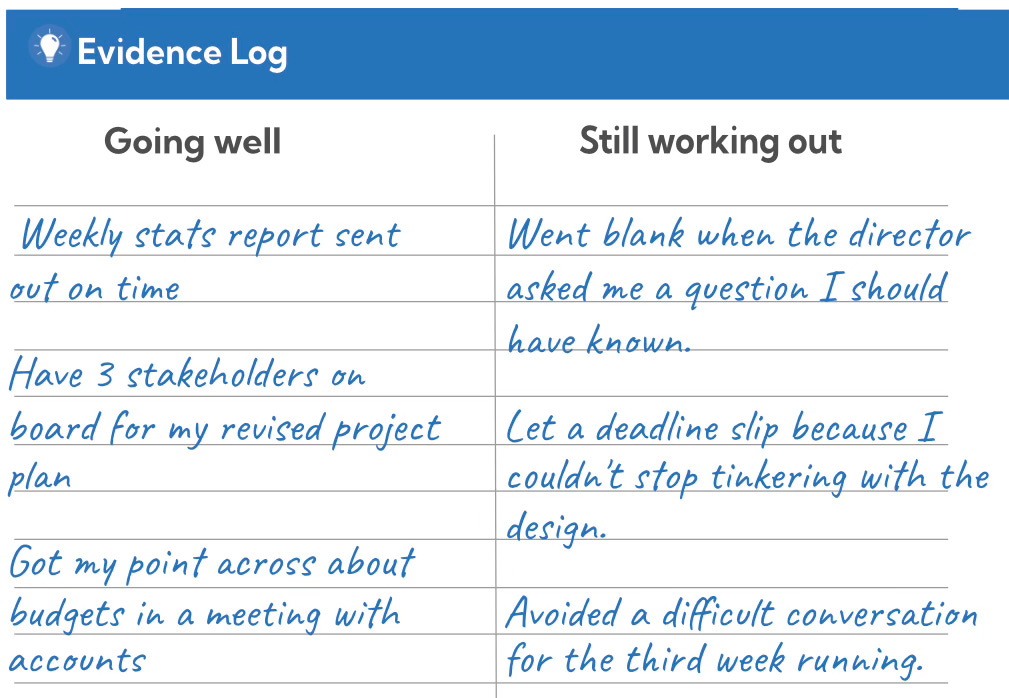
Examples
In the first column: “Going well”
Weekly stats report sent out on time.
Have 3 stakeholders on board for my revised project plan.
Got my point across about budgets in a meeting with accounts.
Learned the new software system.
Created 10 email templates for my most common replies.
In the second column: “Still working out”
Went blank when the director asked me a question I should have known.
Let a deadline slip because I couldn’t stop tinkering with the design.
Avoided a difficult conversation for the third week running.
Spent an hour on a task that should have taken twenty minutes.
Said yes to something before I fully understood what it involved.
This is not a motivational exercise, it’s collecting objective data. The point is to stop inflating failure in your head and dismissing success as “luck”.
3. Run small experiments
Imposter syndrome feeds off untested assumptions.
And assumptions that go unchallenged can skew everything you do. So to test them, you need to nudge out of your comfort zone using small experiments. Start with one or two “slightly scary” actions that challenge assumptions you have made.
Examples:
Ask questions about why things are done the way they are in meetings.
Send work before it’s fully ‘perfect’ but good enough.
Admit you don’t know something to a colleague; how do they react?
These experiments generate useful information. Compare what did you expect would happen with what actually happened. You’ll notice the story in your head of what you expected rarely matches the reality.
What actually changes
These three tools aren’t going to magically make your doubt about your capability disappear, but they will help make it manageable.
And every time you use them you are building your resilience to be with the uncomfortable feelings around being an “imposter”.
Capturing information will also help you to see more clearly what’s going well and what needs more attention. It will help build your confidence and self-worth one step at a time.
Here’s are some additional articles you might find useful.
On making assumptions: The Stories You Tell Yourself and Believe Are True
Stepping out of your comfort zone: Learning to Live at the Edge of What Feels Safe